Today's blog post is about a particularly effective fallacy which runs rampant in MLM called the, "No true Scotsman" fallacy. This fallacy is extremely effective in MLM, because it, much like the other fallacies, does not require any actual evidence to support a claim. Instead, there is a form of closed-logic used to try and shut down any critical faculties in the denier. This type of closed-logic, or sometimes circular logic, is utilized by MLM leaders to neutralize their adherents and keep deniers out. These fallacies are also very easy to parrot, which enables the rhetoric to spread wider and faster, while also creating more cognitive dissonance as the new truth becomes reality.
The "No true Scotsman" fallacy is: "No true Scotsman is a kind of informal fallacy in which one attempts to protect a universal generalization from counterexamples by changing the definition in an ad hoc fashion to exclude the counterexample. Rather than denying the counterexample or rejecting the original claim, this fallacy modifies the subject of the assertion to exclude the specific case or others like it by rhetoric, without reference to any specific objective rule ("no true Scotsman would do such a thing"; i.e., those who perform that action are not part of our group and thus criticism of that action is not criticism of the group)."
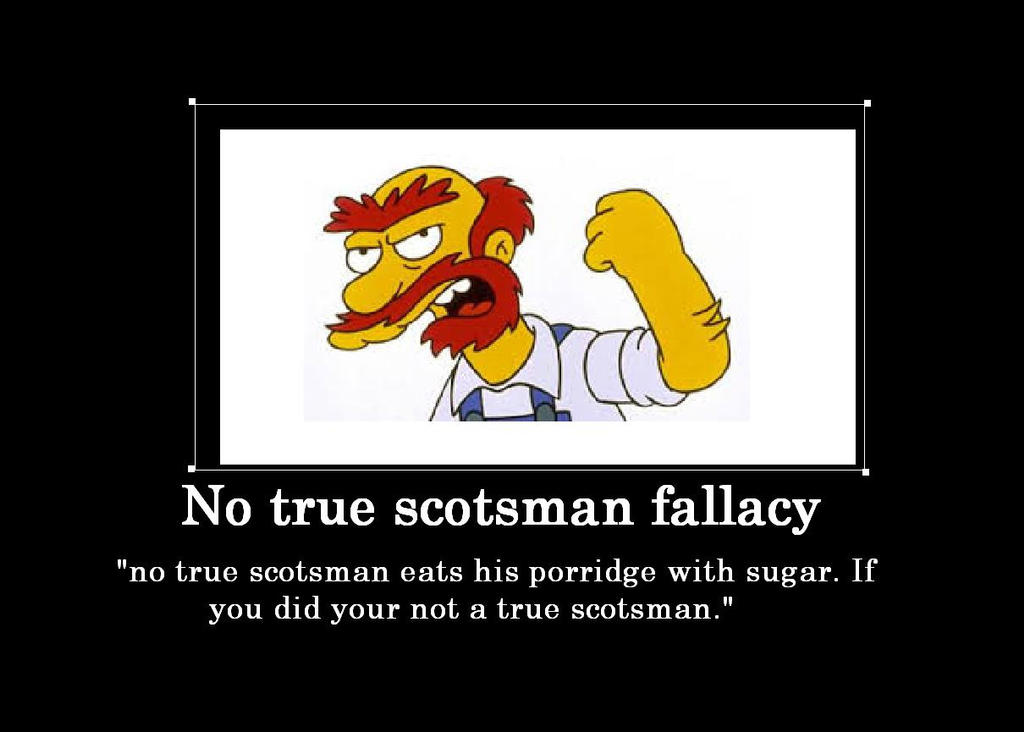
In other words, you can explain away any unique example or criticism by simply saying it isn't a true representation of the group as a whole. MLMs love to explain away any issues they may have by suggesting the MLMer was not a representation of their organization because they, didn't try hard enough, they didn't follow the "system", they didn't explain the "business" correctly, or some other nonsense. This allows them to circumvent any negative statistics, disprove any bad experiences, or justify any losses. Instead of directly addressing the problems, they can simply say, that isn't a true or authentic version of the "business".
It is important to hold the person accountable when they try to use this line of logic. The person needs to provide evidence to assert the example or criticism is unique and is not representative of the group as a whole. Especially when it comes to statistics, it is important for them to provide statistics to refute the point. It is not acceptable for a MLMer to suggest 99% of MLMers failing in their "business" is somehow not important because they didn't follow a "system", or they didn't "try hard enough". That is not a reasonable excuse for the overwhelming failure rates.
__________________________________________________________________________
Source: https://en.wikipedia.org/wiki/No_true_Scotsman
The "No true Scotsman" fallacy is: "No true Scotsman is a kind of informal fallacy in which one attempts to protect a universal generalization from counterexamples by changing the definition in an ad hoc fashion to exclude the counterexample. Rather than denying the counterexample or rejecting the original claim, this fallacy modifies the subject of the assertion to exclude the specific case or others like it by rhetoric, without reference to any specific objective rule ("no true Scotsman would do such a thing"; i.e., those who perform that action are not part of our group and thus criticism of that action is not criticism of the group)."
In other words, you can explain away any unique example or criticism by simply saying it isn't a true representation of the group as a whole. MLMs love to explain away any issues they may have by suggesting the MLMer was not a representation of their organization because they, didn't try hard enough, they didn't follow the "system", they didn't explain the "business" correctly, or some other nonsense. This allows them to circumvent any negative statistics, disprove any bad experiences, or justify any losses. Instead of directly addressing the problems, they can simply say, that isn't a true or authentic version of the "business".
It is important to hold the person accountable when they try to use this line of logic. The person needs to provide evidence to assert the example or criticism is unique and is not representative of the group as a whole. Especially when it comes to statistics, it is important for them to provide statistics to refute the point. It is not acceptable for a MLMer to suggest 99% of MLMers failing in their "business" is somehow not important because they didn't follow a "system", or they didn't "try hard enough". That is not a reasonable excuse for the overwhelming failure rates.
__________________________________________________________________________
Source: https://en.wikipedia.org/wiki/No_true_Scotsman

